 admin
admin 
ISLAMABAD, (MANEND NEWS): The Supreme Court on Friday rejected a request by Attorney General Pakistan Mansoor Awan for the formation of a full court as it continued hearing the Pakistan Tehreek-e-Insaf’s (PTI) petition against the delay in the Punjab Assembly polls.
Chief Justice Umar Ata Bandial said that neither the law nor rules talked about the composition of a full court and they would not ‘go back’ to the start as the matter was being heard since Monday.
The case continued after two judges – Justice Aminuddin Khan and Justice Jamal Khan Mandokhail – recused themselves from the five-member bench.
Today, a three-member bench led by the Chief Justice of Pakistan (CJP) Umar Ata Bandial resumed hearing the matter with the chairperson of the Executive Council of the Pakistan Bar Council (PBC) present before the apex court.
The chief justice maintained that the PBC officeholder would be heard later, to which Pasha stated that the bar had nothing to do with supporting anyone. He suggested that if a full-court bench could not be formed then the SC should hold a full-court session.
The CJP said that the bench was considering taking that measure and added that the relationship between the judges was “good”.
Pasha, however, stated that yesterday and today, two judges excused themselves from hearing the matter, and the CJP told him to meet him in his chambers regarding that issue.
“Today is the first time you have come to the court, prove yourself by actions, not by words,” Justice Bandial advised, reinviting Pasha to his chambers. He added that the president of the Supreme Court Bar had been in touch with him.
“Our life would have been peaceful if it was only about the external image, media personnel also sometimes report wrong things,” the chief justice said, adding that the court always showed restraint.
Justice Bandial maintained that he would conduct some meetings after the hearing and hoped that “Monday’s sun would rise with good news”.
The chief justice stated that the attorney general (AG) could raise whatever point he wanted to, to which the AG requested the court to ‘lower the rising temperatures across the country’ – signaling to the turmoil rising from the disagreement within the court itself.
When asked by the CJP what the AG had done to lower the temperatures, he stated that ‘temperatures may reduce over time’.
Justice Bandial said that the court always gave precedence to the Constitution and that the Constitution and democracy had to be kept alive. He added that those in prison until very recently were now addressing the National Assembly because the people chose them as representatives.
Commenting on the case, he said that the 90-day deadline for holding Punjab Assembly polls as per the Constitution expired in April.
The chief justice continued that the president was supposed to give the date 15 days after the stipulates 90-day period and that the Election Commission of Pakistan (ECP) did not inform the president about the security situation and the problems with holding the polls on April 30.
“If the president had been informed about the situation, the date of April 30 might not have been suggested,” he added. He stated that the matter of holding the elections on October 8 was brought before the court and that the court did not want to create more problems. The CJP directed the parties to give solid reasoning or initiate a dialogue.
“The term of the assemblies will also be completed in August. If there are negotiations between the government and the opposition, a break will be taken for a few days. However, if negotiations do not take place, constitutional roles will be played,” he said.
Justice Bandial stated that if negotiations take place, all points of all participating sides would be mentioned in the judgment. He also inquired about the expenses of Rs20 billion to hold separate polls and the security issue with half the polling stations categorised “highly sensitive”.
Referring to the reason given earlier which highlighted terrorism in the country, Justice Bandial said such elements were present since the 90s. He added that the court was told that the forces were busy at the border and that the matter would also have to be looked into.
The AG highlighted that the court would have to observe the circular issued by the CJP and read the note of Justice Jamal Khan Mandokhail after he quit the bench.
He added that the second matter was the ratio of the judgement of March 1, as well as the order of March 1 as the current petition was based on that.
“Two members of the nine-member bench resigned from the voluntary bench,” the AG said, and on inquiry from the chief justice read out the court order dated February 27 where the matter was referred to the CJP for the reconstitution of the bench.
The AG said that the CJP had stated that the judges did not excuse themselves from hearing the case, to which Justice Bandial replied that he had not said anything in that regard.
Justice Bandial stated that the judges would discuss the order halting the proceedings, and told the AG to focus on lowering the temperature.
“We cannot even respond to criticism. The internal discussions of judges should not be in public,” he said, adding that the matters would be resolved soon.
The AG argued that on the first day, a request was made to constitute a full court, to which the chief justice stated that reasoning must be given for that notion and that the matter of constituting a full court was already on his mind.
“There is a lot to keep in mind while creating a judicial bench, one thing is that routine cases are not affected. In the present era, the number of cases disposed of daily is increasing. Sometimes all judges are not available,” Bandial said, detailing that last week there were benches in Quetta, Karachi and Lahore, as well as a bench in Lahore this week.
He maintained that all judges were considered while constituting the nine-judge bench and listed judges who were experts of the Constitution. The chief justice also highlighted that Justice Mazhar Naqvi was added to send a silent message.
“Justice Faiz Isa’s case went on for two years and the court was punished. For Justice Faiz Isa, the case was a punishment. There is a political case based on which other judges were targeted,” he said, adding that all judges were being targeted on hearsay.
He continued that the SC was unified in some cases and no one saw how the judiciary was being affected, and how people in important positions were targeting the judiciary.
“I am being asked to punish another judge, go and examine the evidence first,” he said, maintaining that the apex court had the best judges in two decades.
“If you talk about law, I will listen as a judge, if you talk about my judges, you will have to face me,” the chief justice said, adding that he had a heart and feelings too.
He stated that whatever he did was done honestly with God as a witness and that whatever was done was done in accordance with the law.
The AGP said he would conclude his arguments quickly and the CJP instructed him to talk about the case, including matters pertaining to finances and funds.
Awan stated that the court should listen to political parties first and he would inform the court at a later time regarding the financial situation.
Justice Bandial said Farooq H. Naik, Akram Shaikh and Kamran Murtaza would also be heard, but he wanted to hear the State of Pakistan first.
Justice Muneeb Akhtar asked him if the elections could be delayed till October 8.
“The matter is not about Rs20 billion, it is about the entire economy. The country is facing a deficit of Rs1,500 billion, and until June 30, the interest rate can go up to 22%. Rising interest rates increase debt,” the AGP said.
The CJP asked if the new rate of interest applied to past loans and Justice Akthar questioned how much money did the government have in the treasury presently, and how much money was there in federal consolidated funds.
“If Rs20 billion is spent, how much will the deficit increase,” he inquired, adding that election expenses were probably less than one percent of the deficit.
“Rs170 billion is expected in the supplementary budget, if the whole sum is collected,” the AG said and informed the court that the funds were under the control of the Ministry of Finance.
Justice Akhtar asked Awan to read the rules of 2019 and inform the court about who controls the funds, asking him to review the rules under the Public Financial Management Act. He added that according to the rules, the consolidated funds are in the State Bank, and instructed the AGP to call the State Bank and ask how much money they have.
“The Election Commission is looking at the government, The commission says that if the funds are available, the election will be held on April 30,” he added.
The CJP contended that having money in the funds and having it available for spending were two different things and that the central bank had to keep money and gold reserves.
Subsequently, the apex court rejected the Attorney General’s plea to constitute a full court for the time being.
Justice Akhtar expressed displeasure over the AGP’s request and termed it “forum shopping”.
The three-judge bench summoned the defence and finance secretaries to provide assistance with holding general elections of provincial assemblies. The hearing of the case was adjourned till Monday.
Justice Mandokhail recuses himself
The bench hearing the PTI plea was disbanded again today after Justice Jamal Khan Mandokhail recused himself.
Earlier, the bench was dissolved after Justice Aminuddin Khan had recused himself, stating he was a signatory to an order issued by a different bench. He had proposed the postponement of all cases instituted under Article 184(3) of the Constitution.
However, earlier today, a new four-member bench was formed excluding Justice Khan.
Justice Mandokhail said that yesterday’s order – which stated that the remaining SC bench disagreed with Justice Aminuddin and considered that the hearing and proceedings in the petition remained unaffected – was passed without his consultation, therefore, he was a ‘misfit’ on the bench.
In a handwritten note on the order, Justice Mandokhail said that “the order was not dictated in the court, nor was I consulted by the honourable chief justice”.
“However [the] impact of the judgement requires consideration in court,” he added.
Chief Justice of Pakistan (CJP) Umar Ata Bandial then said that they would shortly pass an order about the composition of a new bench.
CJP disregards judicial order by Justice Isa, Aminuddin
Chief Justice of Pakistan (CJP) Umar Ata Bandial on Friday exercised administrative power and disregarded the judicial order issued by Justice Qazi Faez Isa and Justice Aminuddin Khan, stating that it violated the rules laid down by a five-judge larger bench.
On March 29 an SC bench held that all cases that various Supreme Court benches were hearing under Article 184 (3) of the Constitution be postponed until amendments are made in the Supreme Court Rules 1980 regarding the discretionary powers of the CJP.
The three-judge bench led by Justice Qazi Faez Isa and comprising Justice Aminuddin Khan and Justice Shahid Waheed issued the verdict with a vote of 2 to 1 with the dissenting note by Justice Waheed.
Yesterday, when the five-judge bench resumed hearing the polls postponement case Justice Aminuddin Khan—who had endorsed Justice Isa’s ruling on Wednesday—announced that he wanted to recuse himself from hearing the case.
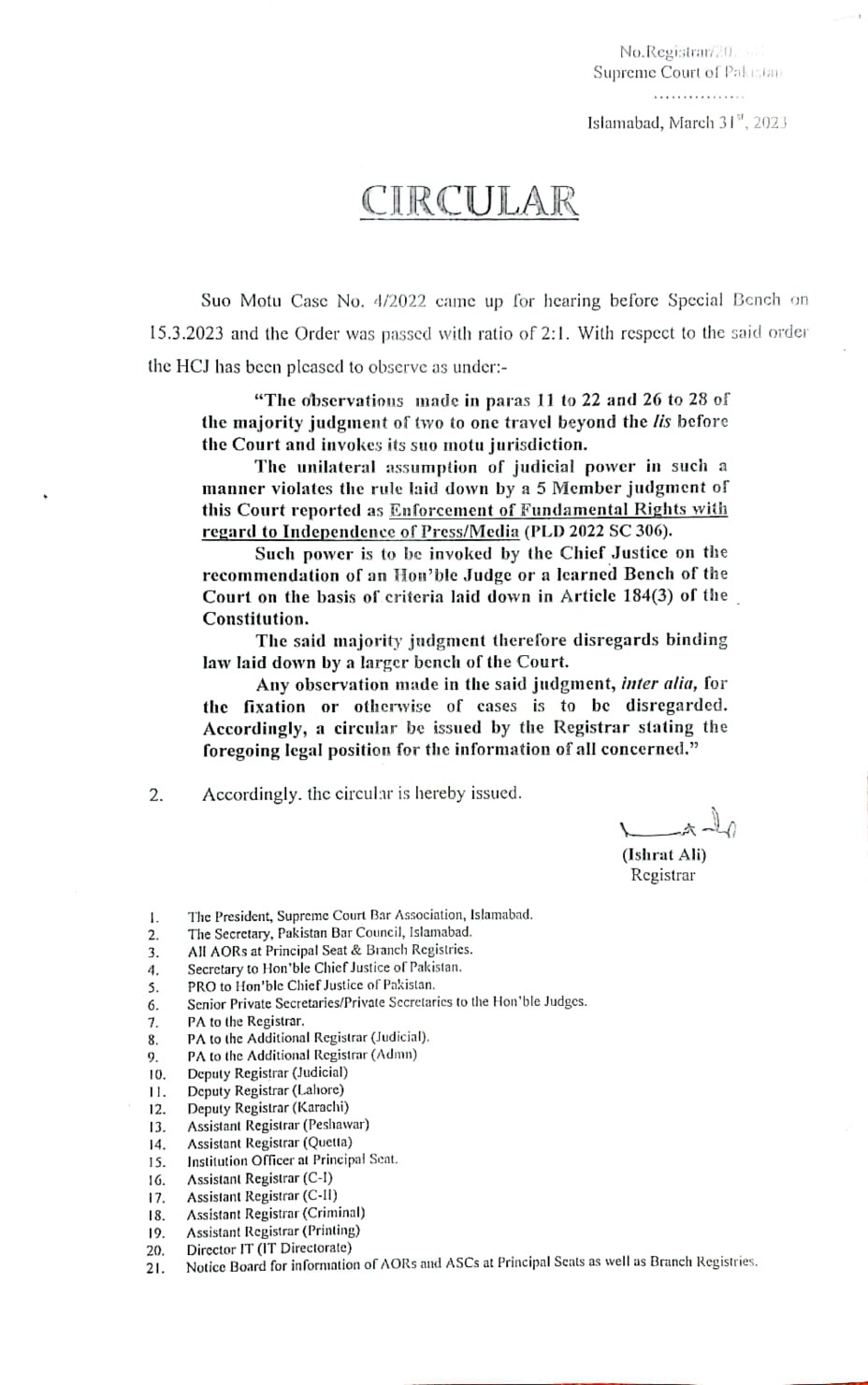
With respect to the order passed by Justice Isa, the chief justice issued a circular stating that the “observations made in paras 11 to 22 and 26 to 28 of the majority judgement of two to one travel beyond the lis before the Court and invokes its suo motu jurisdiction”.
It continued that the “unilateral assumption of a judicial power in such a manner violates the rule laid down by a five-member judgement of this Court reported as Enforcement of Fundamental Rights with regard to Independence of Press/Media”.
“Such power is to be invoked by the Chief Justice on the recommendation of an honourable judge or learned bench of the Court based on the criteria laid down in Article 184(3) of the Constitution”.
Article 184(3) of the Constitution of Pakistan gives the Supreme Court the extraordinary power to assume jurisdiction over any “question of public importance with reference to the enforcement of any … Fundamental Rights”.
The circular stated that “the said majority judgement, therefore, disregards binding law laid down by a larger bench of the Court”.
“Any observation made in the said judgement, inter alia, for the fixation or otherwise of cases is to be disregarded,” it concluded, adding that the circular was issued by the Registrar stating the foregoing legal position for the information of all concerned.
The circular comes shortly after the Senate passed the Supreme Court (Practice and Procedure), Bill 2023 – aimed at curbing the top judge’s suo motu powers in an individual capacity amid protest by the opposition.
Sixty votes were cast in favour of the bill and 19 against it. Law Minister Azam Nazeer Tarar submitted a motion in the house to present the bill in the house, which met under the chairmanship of Sadiq Sanjrani.
The opposition’s motion to hand over the bill to the standing committee was rejected whereas a motion to pass it immediately was approved.