

 admin
admin 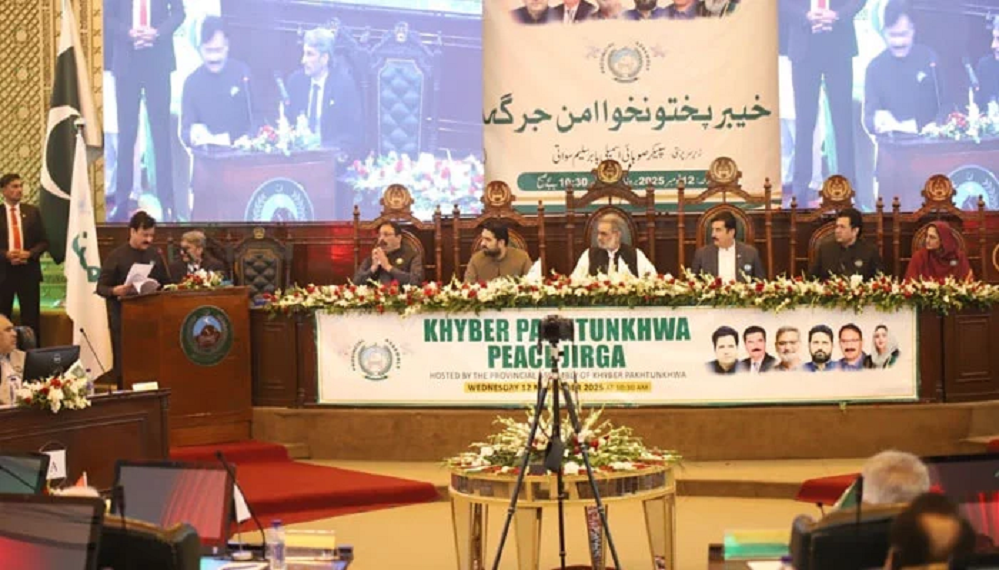
Islamabad (Manend News) Khyber Pakhtunkhwa Chief Minister Sohail Afridi on Wednesday called for a “shift” in the Centre’s counterterrorism policies by including all stakeholders in the decision-making process, as his government convened a multi-party jirga.
The peace jirga had been called by the KP government to discuss the law and order situation in KP and discuss strategies for re-establishing peace in the province. At the previous jirga held in the Khyber district on October 25, CM Afridi had warned against launching any new military operation in the tribal districts.
“I expect that a durable and permanent solution to this menace of terrorism, which has been eating away at Khyber Pakhtunkhwa for more than 20 years, will be found,” CM Afridi said while addressing the moot.
The KP CM called for a policy shift, which he said would entail “coming out of the closed rooms, considering other individuals intelligent, considering politicians as wise”, and including security forces, stakeholders of KP, leaders of all political parties, and members of all schools of thought in the policymaking process.
Afridi added that the policy should not be a short-term one where terrorism could see a resurgence after a few years, but one that “wipes out the menace of terrorism from Khyber Pakhtunkhwa for once and for all”.
KP Governor Faisal Karim Kundi, who is seated on the same stage as Afridi and others, is attending the event at the invitation of the provincial government. Representatives of the Centre were also expected to attend.
The Awami National Party (ANP), Jamiat Ulema-i-Islam-Fazl (JUI-F) and Jamaat-i-Islami (JI), all of which are part of the opposition in the KP Assembly, are participating in the moot as well.
KP Speaker Babar Saleem Swati is chairing the jirga, with PTI MNA Junaid Akbar and PML-N’s Ibadullah Khan, the opposition leader in the KP Assembly, also seated on the stage.
At the outset of his remarks, CM Afridi welcomed all attendees from various segments of political circles and civil society.
“We repeatedly speak of peace, but unfortunately, some people dislike it,” the chief minister said. Noting that terrorism needed to be eliminated for peace to be achieved, CM Afridi said militancy had not been eradicated by “decisions taken behind closed doors and imposed on us”.
“Our politics is each of our own, but our peace is shared,” the chief minister said, highlighting that all political parties and the public of the province had given sacrifices in the war against terrorism.
“Our security forces, whether it’s the army, the police or the CTD, they all gave sacrifices and then peace was established in 2018,” Afridi noted.
The chief minister said war should be the last option for resolving any issue.
CM Afridi reiterated the call for KP being given its complete due share in the National Finance Commission (NFC), which he said amounted to around Rs400 billion. He added that while erstwhile Federally Administered Tribal Areas had been merged administratively with KP, the economic merger was still not complete.
Addressing the jirga, senior PTI leader Asad Qaiser urged the Afghan government to address the ongoing issues, and also demanded that the federal government utilise diplomatic channels.
“Pakistan and Afghanistan cannot survive without each other,” the former National Assembly speaker emphasised.
Akbar also said the decision to join the Afghan war in the 1970s was “never a political but a decision by the military”.
“They [the military leadership] told us that these are our people and they would be rehabilitated,” he said, claiming that the entire political leadership had expressed reservations.
The KP speaker said that while there was “no doubt” that the country possessed brave armed forces, it “makes you think that peace is not being established despite having intelligence [operations]”.
The jirga began with prayers for those martyred in terrorism across the province.
ANP KP President Mian Iftikhar Hussain and former JI emir Sirajul Haq, as well as delegations of the JUI-F and the Pakhtunkhwa Milli Awami Party (PkMAP), are participating in the peace jirga.
Former CM Mahmood Khan, ex-governor Shaukatullah Khan, Pakistan Mazdoor Kisan Party central chairman Afzal Shah Khamosh, lawyers, and stakeholders from various schools of thought are among other attendees.
The moot comes amid a recent spate of terror attacks across the country, with the federal capital also witnessing a rare deadly blast yesterday that killed at least 12 people.
The terrorism situation in KP also remains concerning. In Dera Ismail Khan’s Daraban tehsil, a bomb attack targeted a security forces’ convoy yesterday, injuring at least 14 personnel.
On Monday, the Cadet College in South Waziristan’s Wana came under attack. While all students and teachers were reported to have been safely rescued and all terrorists holed up inside the building were killed, the clearance operation resulted in the martyrdom of three individuals.
“The actions by the enemies of peace in Bannu, Wana, and Islamabad before the jirga are a conspiracy to sabotage the peace process. The enemies of peace will fail, and peace is our future,” former KP minister Kamran Khan Bangash said on X before the moot began.
Swati and Deputy Speaker Suriya Bibi were welcomed by a police contingent when they arrived at the venue.
PPP parliamentary leader in the KP Assembly Ahmad Karim Kundi had hailed the decision to hold the peace jirga, noting that the poor law and order situation was the biggest issue faced by the province.
He said that while political parties had held jirgas for peace, a jirga was being held at the provincial assembly for the first time, representing the will of 40 million of the province.
JUI-F provincial emir Senator Maulana Attaur Rehman and provincial general secretary Senator Maulana Attaul Haq Dervesh were to represent the party in the jirga, according to party spokesperson Abdul Jalil Jan.
From the JI, party leaders Prof Mohammad Ibrahim Khan and former senior minister Inayatullah Khan were to attend the peace moot, a spokesperson had told Dawn.
‘Peace above politics’
“Peace is more important for us than politics,” PTI’s Qaiser said before the jirga began, pointing out that political leaders of the entire province had been gathered today.
Qaiser welcomed the participation of all political parties, including those in the opposition. “We will formulate a national policy through this jirga,” he said, adding that his party will present their demands before the Centre related to counter-terrorism.
The PTI leader, reiterating his party’s stance, said the Pak-Afghan tensions should be resolved diplomatically. “There will be peace in Pakistan once there is peace in Afghanistan,” he said, adding that the KP government will also present its demands before the Afghan ruling administration.
Echoing Qaiser’s sentiments, PML-N’s Ibadullah told the media, “We have set aside a myriad of differences and are sitting with the PTI.”
He highlighted that a jirga was being convened in the KP Assembly for the first time and said he was hopeful for a positive outcome of it.
The KP opposition leader noted that today’s moot had a single-point agenda of peace. “Terrorism is the number one issue. Amendments are the parliament’s matter,” he said.
“There should be no talks with terrorists,” Ibadullah asserted. “There will be no pardon for those who slew our children’s heads.”
‘No more good Taliban, bad Taliban’
Addressing the jirga, ANP’s Mian Iftikhar said that there should be “no more good and bad Taliban” narrative, and that the policies of the past should no longer continue.
“A complete implementation of the National Action Plan is important for eradicating terrorism and establishing peace. We can only make suggestions as the government would have to implement them,” he said.
“The government must own it. The ANP bravely faced militancy, and we held talks but also owned the problems. We took all the stakeholders and launched an operation, cleared the Malakand division and rehabilitated the displaced people,” he said.
Regarding Pakistan’s relations with Afghanistan, Mian Iftikhar said: “Both countries should respect each other and only dialogue could resolve the issues. All the trade routes with Afghanistan should be reopened immediately, and the border economy promoted. The federal and provincial governments must sit down and resolve issues.”
‘What happened to past peace jirgas?’
Shedding light on the importance of holding talks and reaching consensus, Mehmood Khan asked the participants: “I wonder what happened to the past peace jirgas?”
“You are the government, and people gave you the mandate,” he said, addressing the provincial government. You will have to sit with the ‘key stakeholders’ and talk to them. A jirga comprising these people should be formed to discuss issues related to the province’s rights with the federal government.“